Most people asking this question have already tried the easy things — a plug-in, a coil, closing the windows at dusk — and want to know whether a screen is actually a better answer. It usually is, but only if you get two details right: the mesh and the seal. Everything else is preference.
Here is what separates a screen that works from one that quietly lets insects through.
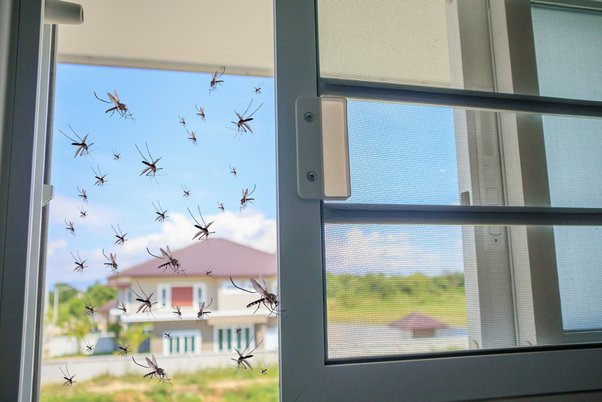
Do fly screens really stop mosquitoes?
Yes — and this is not a marketing claim. The World Health Organization lists window and door screens among the measures that reduce contact between mosquitoes and the people inside a building, alongside nets and air conditioning. The CDC gives the same advice, with an important addition: repair holes in screens.
That second half is where most failures happen. A screen is a physical barrier. Barriers do not work partially.
What actually stops a mosquito: hole size
An adult mosquito cannot pass an aperture much under 1.2 mm. Standard insect netting sits at roughly 285 holes per square inch, which is comfortably fine enough while still letting air through. That is the grade on most fly screens in the UAE, and for mosquitoes it is sufficient.
Going finer is not automatically better. Tighter weaves cut airflow, trap more dust and need cleaning more often. Fine mesh earns its place when the problem is smaller insects — midges, sand flies, thrips — not mosquitoes.
| Mesh grade | Stops | Airflow | Best for |
|---|---|---|---|
| Standard fibreglass | Mosquitoes, flies, wasps | Very good | Most homes, most windows |
| Fine mesh | The above plus midges and sand flies | Reduced | Ground floors, gardens, waterside |
| Pet-resistant | The above, and survives claws | Good | Doors in homes with cats or dogs |
If you want the longer comparison including frame materials, we cover it on the fly mesh for windows page.
The detail that decides everything: the perimeter
A screen is only as good as its worst edge. Mosquitoes do not chew through mesh — they walk around it. The three gaps that matter:
- The closing edge. A brush seal or magnetic strip along the edge where the panel meets the frame. Without it, there is a permanent slot.
- The top and bottom rails. Screens cut down from a kit often leave a few millimetres at the head or sill.
- The corners. Mitres that have opened up with heat are a common failure on older screens.
This is the practical argument for measured screens over trimmed kits. A screen built to the opening seals on four sides by design rather than by luck.
Which screen type suits which opening
All of the types below use the same mesh. What differs is how the screen gets out of the way when you do not want it.
| Type | How it moves | Suits |
|---|---|---|
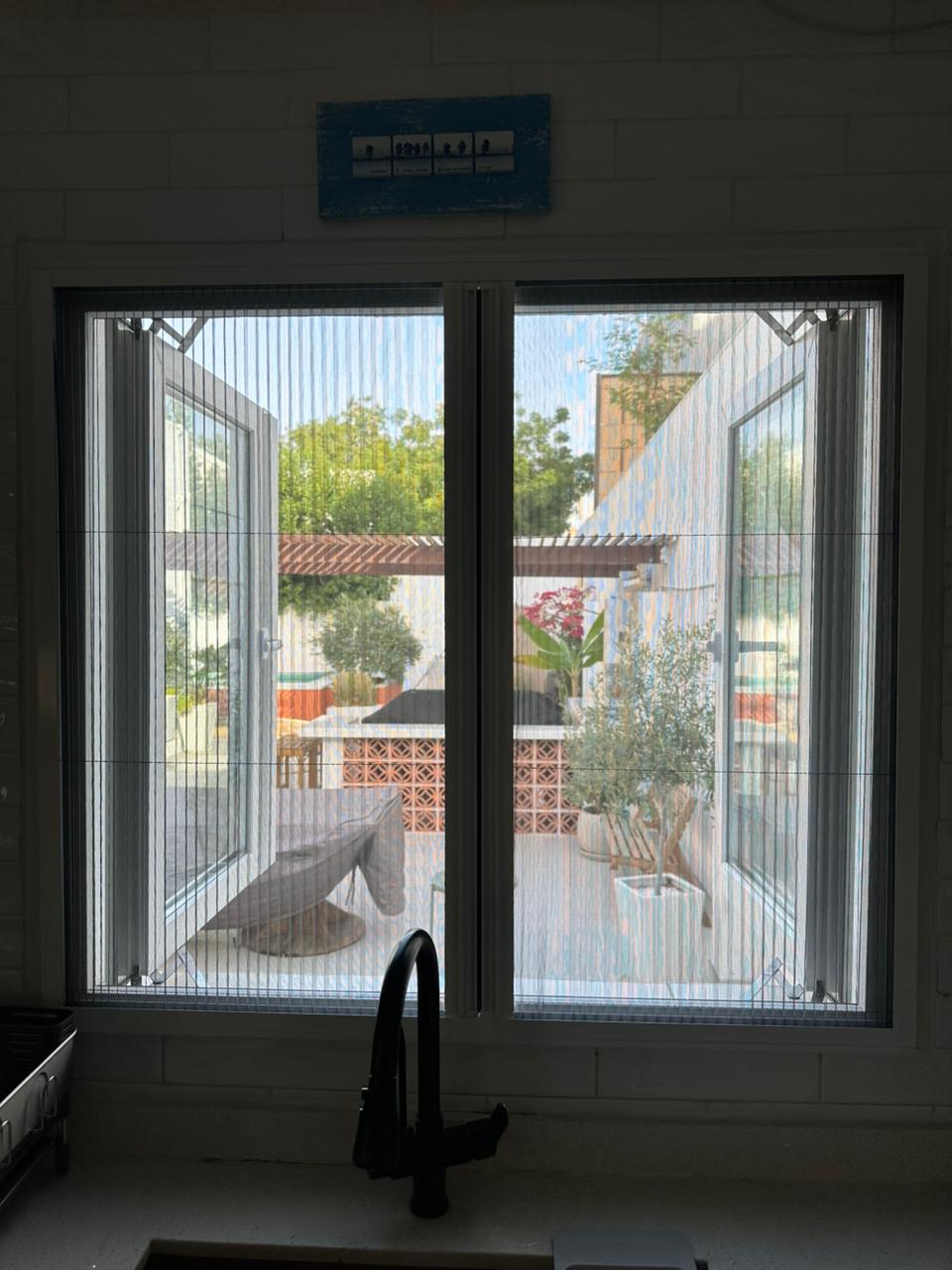
| Single pleated | Folds to one side into a slim cassette | Standard windows and single doors |
| Double pleated | Closes from both sides | Wide openings and patio doors |
| Retractable | Rolls into a housing on a spring | Openings you want visually clear |
| Motorised | Opens and closes on a motor | High or hard-to-reach glazing |
| Fixed | Does not move at all | Windows that are rarely opened |
| Sliding panel | Runs on its own track | Balcony and terrace doors |
| Roll-up | Pulls down vertically | Kitchen and utility windows |
Screens compared with the alternatives
People usually arrive at screens after trying something else, so it is worth being straight about the trade-offs.
Plug-in vaporisers and coils work while they are running and only in the room they are in. They are consumables, and many households would rather not run them continuously around children or pets.
Repellents on skin protect the person wearing them, not the room. Useful outdoors, irrelevant to whether mosquitoes are indoors at 3am.
Keeping windows shut and the AC on works, and it is what a lot of UAE households default to. It also means the air conditioning runs during the months when the outside air is actually pleasant. A screen is what buys back those evenings.
Electric zappers attract insects towards the house. They are best kept well away from where people sit, and they do nothing about what is already inside.
The honest position: a screen is the only one of these that works continuously, needs no consumables and does not put anything into the air. That is why it is the baseline rather than the last resort.
What a screen will not do
A screen is an insect barrier. It is not a security product, and it is not fall protection. A mesh panel will not hold the weight of a child leaning on it. If you have young children and openable windows above ground level, that is a separate problem needing a restrictor or guard — we cover the distinction in protecting a baby’s room from mosquitoes.
Keeping screens working
UAE conditions are hard on mesh. Sun makes polymers brittle over time, and airborne sand abrades the weave and clogs the tracks. Two habits cover most of it: vacuum the mesh on a low setting every few months, and keep the bottom track clear. The fuller routine is in our fly screen maintenance guide for the UAE climate.
When mesh finally goes, the frame is usually fine. That is a mesh replacement job, not a new screen. If you are not sure which you need, this decision guide walks through it.
Questions we get asked
Which screen is best overall?
There is no single winner. For a standard bedroom window, a single pleated screen in standard mesh is hard to beat on cost and airflow. For a balcony door used daily, a sliding panel lasts longer. Match the mechanism to how the opening is used.
Does darker mesh see better or worse?
Darker mesh disappears from view more readily because it reflects less light back at you. Charcoal and black read as clearer than white from inside, despite being the same weave.
Will a screen stop the view or the breeze?
Standard mesh takes a modest amount of light and airflow. Most people stop noticing it within a week. Fine mesh is more noticeable, which is why it is worth only fitting where it is needed.
How much should this cost?
It depends on the opening and the mechanism rather than the mesh. Current pricing by type is on the fly screen price page.
Not sure which type suits your home? Book a free measurement visit and we will look at the openings before recommending anything. You can also browse all screen services or start from the homepage.