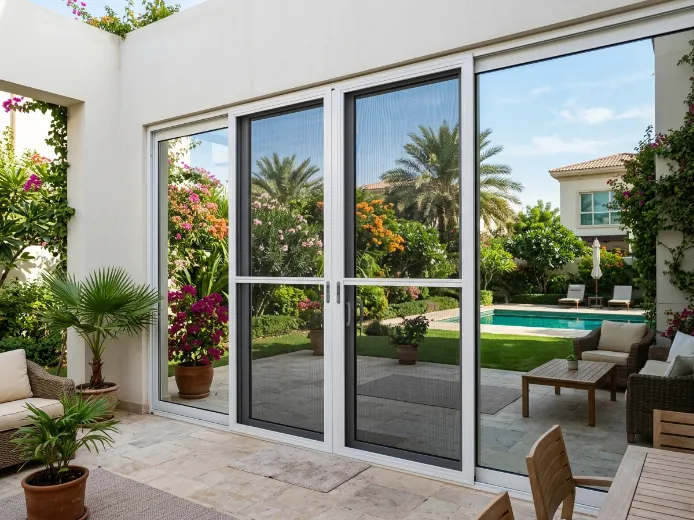
Quick answer: A barrier-free mesh system is a fly screen with no raised track on the floor. It hangs from a top rail or runs in an ultra-low, flush guide, so you can walk, roll a wheelchair or push a pram straight through the doorway. It is the best choice for balcony and patio doors, homes with elderly family members, and anyone who is tired of tripping over or cleaning a bottom track.
Most people never think about the bottom of a fly screen until they trip over it. A traditional sliding screen runs in a raised floor track that catches toes, collects sand and gets in the way of anything with wheels. A barrier-free mesh system removes that obstacle.
This guide explains how barrier-free screens work, who benefits most, and which type suits which door in a Dubai home.
What “barrier-free” actually means
The term covers fly screens designed so the floor of the doorway stays level and clear. There are two main ways to do it:
- Top-hung screens: the mesh panel is carried by a rail at the top of the frame, with nothing fixed to the floor. Our hinged fly screen works this way, which is why it is so popular on apartment balconies.
- Low-profile pleated screens: a retractable pleated screen with a very slim bottom guide, only a few millimetres high, that you step over without noticing.
Both keep mosquitoes out just as well as a traditional screen. The difference is what happens at your feet.
Six advantages of a barrier-free mesh system
1. No trip hazard
This is the main reason people choose one. Children running in from the garden, older parents, guests who do not know the house: nobody catches a foot on a track that is not there.
2. Wheelchair, walker and pram friendly
A level threshold matters enormously if someone in the home uses a wheelchair or walker. It also makes life easier with prams, shopping trolleys, suitcases and robot vacuums.
3. Nothing to collect sand
In Dubai, a raised floor track fills with fine sand within days. It makes the screen stiff and needs constant cleaning. With no track, or a flush one, there is very little to sweep.
4. A cleaner look
When the screen is folded away, the doorway looks as if there is no screen at all. That matters on a large patio opening where you want the garden and the room to feel connected.
5. Works on uneven thresholds
Many balcony doors have a stepped or sloping sill. A top-hung screen does not need a level floor to run on, so it suits doors where a traditional track would never sit flat.
6. Easier for everyone to use
Barrier-free screens slide or fold with a light touch, so children and older family members can open and close them without help.
Are there any downsides?
A few, and it is better to know them before you order:
- Very wide openings may need a double screen or a motorised option so each panel stays stable.
- Strong wind on high floors puts more load on a top-hung panel. Keep the screen fully closed or fully open in a gusty spell.
- Precise fitting matters. With no bottom guide to hide small errors, the screen has to be measured and fitted carefully, which is why we do not sell these as DIY kits.
Barrier-free vs traditional sliding screen
| Barrier-free mesh system | Traditional sliding screen | |
|---|---|---|
| Floor track | None, or flush and very low | Raised track |
| Trip risk | Very low | Moderate |
| Wheelchair access | Yes | Difficult |
| Sand build-up | Minimal | Frequent cleaning needed |
| Uneven thresholds | Suitable | Often unsuitable |
| Appearance when open | Almost invisible | Track always visible |
Which doors benefit most
- Apartment balcony doors, especially with a raised sill. Read more in our guide to fly screens for balcony doors.
- Villa patio and pool doors where people walk in and out barefoot.
- Homes with elderly relatives or anyone using a mobility aid.
- Kitchen doors used with full hands. A two-way fly screen is another good option here.
How to measure for a barrier-free screen
Because there is no bottom track to take up the difference, measuring is more exact than with a standard screen. We measure the width at the top, middle and bottom, and the height on both sides, then make the screen to the smallest figure so it runs freely without gaps. This is all done at a free home visit, so you do not need to measure yourself.
Cost
Barrier-free door screens are made to order. Single pleated door screens start at AED 800 and double door screens at AED 950, while hinged screens are priced after measurement. See our full price list or compare every option on the fly screen for doors page.
Frequently asked questions
What is a barrier-free mesh system?
A fly screen with no raised track on the floor. It hangs from a top rail or runs in a flush, very low guide, so the doorway stays level.
Is a barrier-free screen suitable for wheelchairs?
Yes. With no raised track, a wheelchair or walker can roll straight through the doorway.
Does it keep mosquitoes out as well as a normal screen?
Yes, as long as it is measured and fitted precisely. The seal comes from the side and top profiles and a close fit at the bottom.
Can a barrier-free screen go on a sliding balcony door?
Yes. It is one of the most common places we fit one, especially where the sill is raised or uneven.
Want a doorway with nothing to trip over? We will measure your doors for free and show you which barrier-free option fits.